Tag Archives: Metallica

Interview with George Kollias

Share

George Kollias is a world renowned and much accomplished drummer from Greece. He is best known as the drummer of the American Death Metal band, Nile. He is also a very sought-after drum teacher and conducts power packed drum clinics all over the world. WTS caught up with him for a tête-à-tête, where he spoke at length about his drumming style and techniques and his inspirations. Read on to find out where India lies in Nile’s and George’s future plans…

WTS: Expression in drumming has to do with dynamics and the idea of ‘playing with feel.’ How do you incorporate this into your drumming style?

George: For death metal, there’s not enough dynamics, you’ve to be very solid and as less dynamic as possible. For other styles of music, of course you need dynamics, you know, it’s a big point of the expression. For example, if you are playing jazz music or folk music, you gotta have lots of dynamics always. For death metal, not so much. It’s a different style, we need more speed and stamina instead of dynamics. And I always try to approach any style I’m playing in the best possible way.

WTS: A lot of drummers want to know why you use one pedal to play blast-beats when there are double bass pedals available.

George: Well, umm, the main reason is, because of some of my favorite drummers when I started playing. Like Pete Sandoval from Morbid Angel, he was doing wonderful blasts. The truth is, where I grew up, in a small town about an hour from Athens, there were no metal drummers. I didn’t actually know two feet blasts, so I had to do one foot blasts. When I learned the easier way, it was too late, because I was too fast already! (laughs)

WTS: We’ve noticed that you use your wrists instead of swiveling the sticks in your fingers when playing quick. Is there any particular reason for approaching speed-drumming this way?

George: Yeah, that’s another reason, you know I was looking upto old school drummers, like Pete Sandoval, Dave Lombardo, Igor Cavalera. I grew up (listening) to these guys, and back in the day everyone was mostly using wrists. So till today, you have these drummers who are using mostly wrists for speed. And its again too late cos, you know, I can go as fast as I can with wrists and there’s no reason to change anything right now. But the main reason again, like the one foot blast, is that I didn’t know the other way! (laughs) I just wanted to play traditional metal.
Interview with George Kollias

WTS: Have you ever drummed using wrong techniques and incurred injuries because of it?

George: Umm, never. I got few injuries here and there because of playing too much or not warming up. You know, we go on tours so much and I have to warm up everyday and somewhere in the middle of the tour it gets a little bit boring, there is no room to warm up. So, I’m like “You know what, let’s go without warming up.” That’s quite wrong for metal. Yeah, so, I’ve had few minor problems here and there and that’s only because I didn’t warm up.

WTS: So, your advice to prevent any such injuries is to warm up before playing?

George: Yeah, these days I’ve a personal doctor and what he suggests, and which I always do, and I don’t have a single problem since, is to stretch. So, he gave me a couple of stretching exercises and everything works so much better, you know. For death metal, you have to warm up and stretch a little bit, and it’s a different kind of music, you know. If I were playing a jazz gig or something, I would never warm up – it’s just different for metal.

WTS: So, do you play at jazz gigs as well?

George: Not gigs, but I practice, I practice a lot. I actually have a trio, but we don’t play so often and we have no plans for shows. It’s for fun and, you know, to develop a better technique, become a better drummer. That’s basically for fun and for myself.

WTS: You’ve learnt from the great Yannis Stavropoulos. What is it that you can share as the crux of your learning? There are a lot of drummers out there who envy your technique and style!

George: We did some rock drumming and we did some jazz drumming. When I started the lessons with Yannis – it was just a year, you know – when I started the lessons, I was already a well-known drummer here and I was fast to play in any band. So, what he basically did was, open my mind to new drumming techniques, new drumming approaches, different styles- jazz drumming or, you know, funk music and also, he helped me so much in how to become a teacher, how to understand what I’m doing and how to explain how I came up with my own exercises and stuff. He was also a huge part of my DVD. We were watching my exercises and he was giving different names (to them), suggesting different things. So, basically, he’s my older brother right now, he’s my mentor. We always hang out, talk drums. Today this is actually what I need. He always helps me out, man, always.
Interview with George Kollias

WTS: About your drum kit – would it be right to say that it’s built for a rather ambidextrous approach?

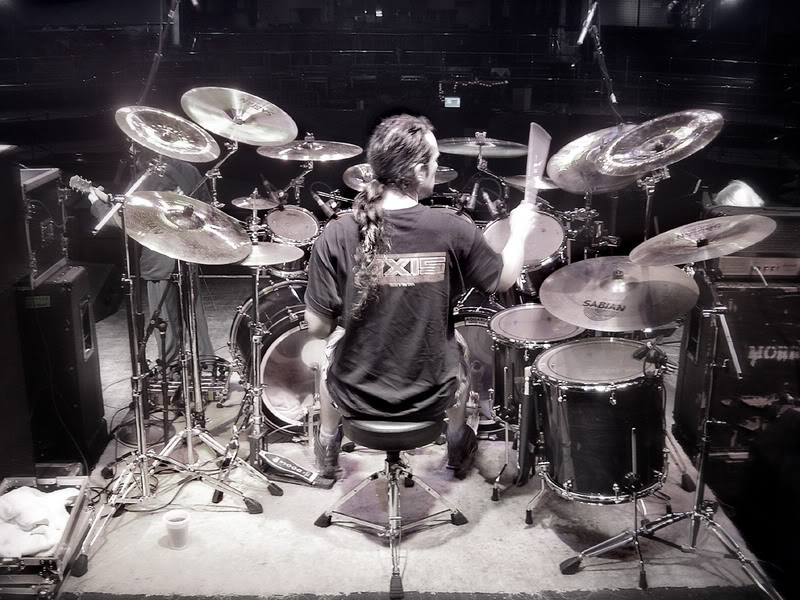
George: Yeah, yeah, it’s an extreme metal drum kit, a big one. You know what’s interesting – lately I’ve been interested in the smaller drum kits. So, to me when I wanna have fun, I’m usually practicing on my small kit, which is like one tom, one floor tom, right cymbal, high-hat, that’s it. Very very simple. But for metal I’ve to play this big drum set. When you tour, there are too many things to worry about, too many cymbals, we’ve to carry too much of gear all the time. You gonna have atleast two drumsets if you’re going to have some serious practice.

WTS: Can you tell us more about your drumkit?

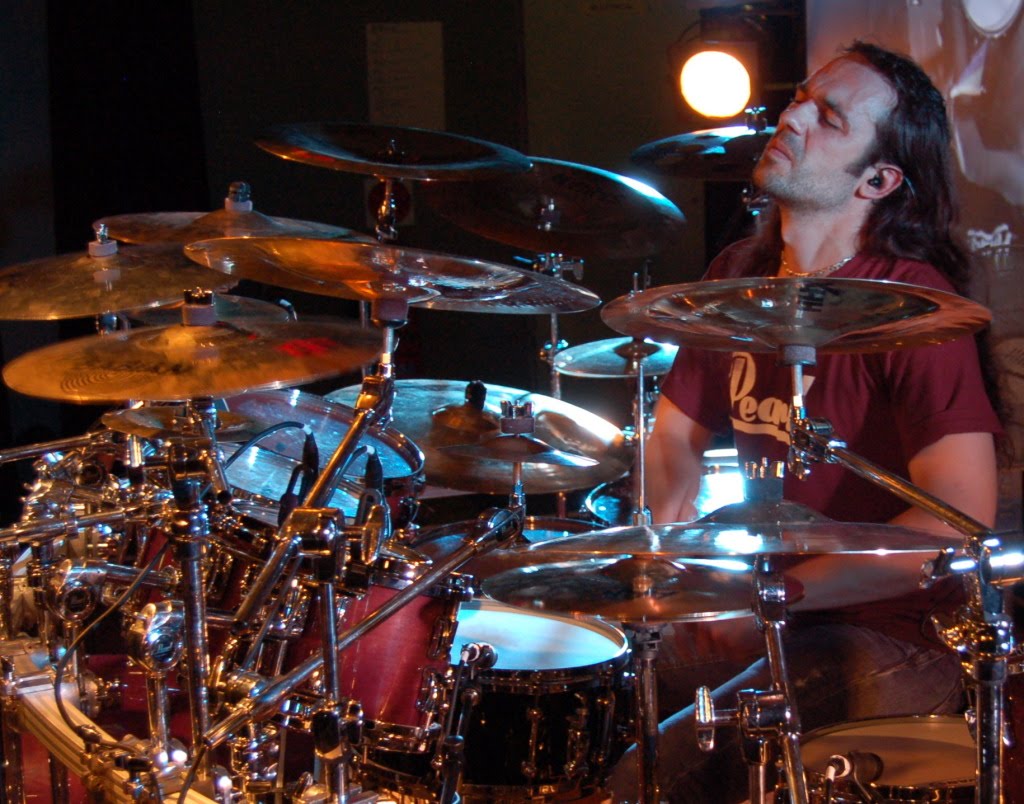
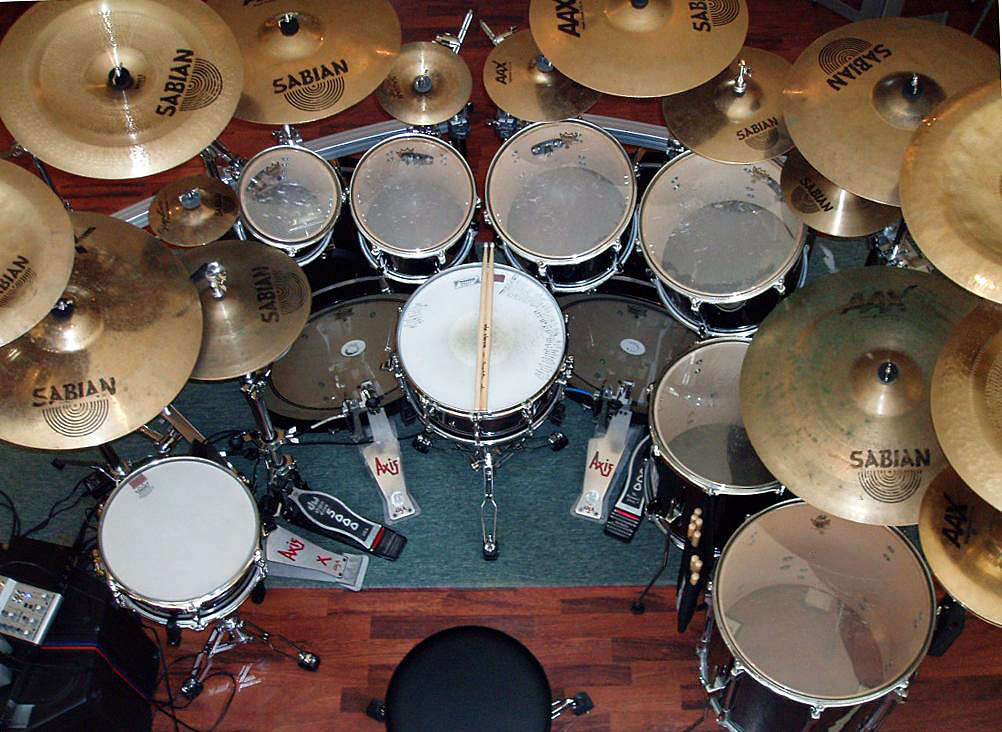
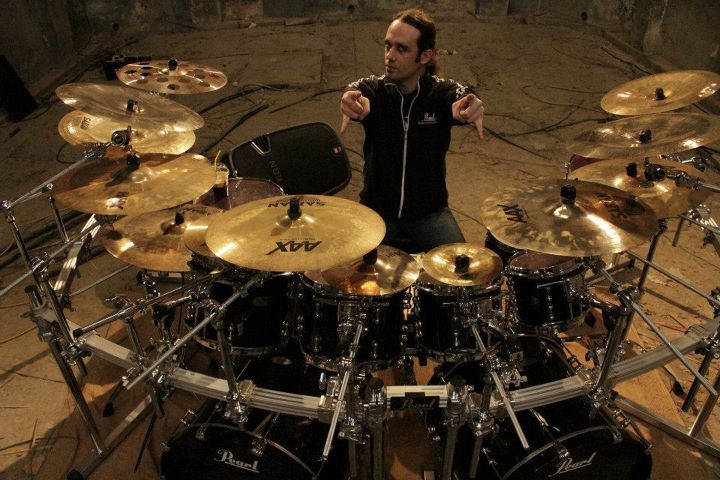
George: I use three floor toms, that’s two on the right side and one on the left. I use two snares – one 14 inch, my main snare, and one 12 inch snare. Two kicks 22/18. That’s it for drums. It’s all Pearl. I have a Pearl Masters Premium and I’ve my main kit which is Pearl Masterworks, that’s custom made drums. These days I’m expecting my new Pearl Reference Pure. This is the brand new model from Pearl based on the old successful Reference series, but I think the new one is better and more versatile to other styles of music as well. Like I said everything is from Pearl! I play Sabian Cymbals, Evans drumheads, and I play Axis pedals. I also use Extreme headphones and have been playing Vic Firth drumsticks for 22 years or so! (laughs) And right now, right next to me I’ve my new signature drumsticks, which, you know, we’re working on new prototypes at Vic Firth. So, my personal signature drumstick is one the way right now and I think it will be ready in about a month and released. Something, I’m really really proud and really really happy.

WTS: Will you be bringing those to your next show in India?

George: I don’t know if they are gonna be ready, but I got some prototype here. We’ve got 3 different models which I checked and we develop my own signature model, but the stick I was using in the past, and I still use, is the Vic Firth 55A, which, of course, has my signature on. But, I don’t know whether my signature model will be ready by then.
Interview with George Kollias

WTS: While looking at the picture of your drumkit, we see a lot of Sabian AAX and HHX series cymbals. What is it about these series that draws you to them?

George: Well, the AAX are studio cymbals. They’re versatile and you can play any style with these cymbals. So, that was my first approach. The HHX series, they are more smooth and dark, (which I use for) more dynamical purposes. Like I said, I use stuff I would use for other gigs as well. So, my drumkit looks metal, but it’s not only for metal. You can play rock music, you can play, not jazz music, but many different styles on it and this is what I do also. Last two months I did some recording sessions for some really weird different bands, like I played for a punk band, I played for a band – they were progressive like Porcupine Tree stuff. So, all the time I was using (the same cymbals) for more sound options and that’s the reason I don’t use AAX metal crashes, because they’re only for metal. So, my crashes are (the ones on which) you can play different styles. Cymbals are never enough, never enough. You can have 50 cymbals and you will need more, that’s for sure.

WTS: Who among the current crop of extreme metal drummers do you follow and admire?

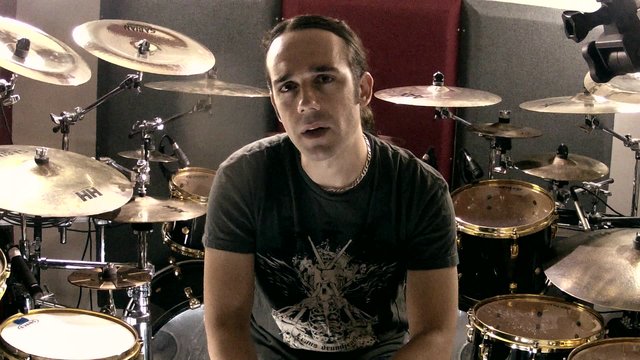
George: Extreme metal drummers? To be honest, nobody. I kinda lost interest for extreme metal drummers, because we do so much, we talk about this so much – I teach extreme metal class and all these clinics all over the world. So, what I really need is different drummers. Do you understand what I’m saying? I mean there are many great extreme metal drummers – one is Dave Haley from Psycroptic from Australia. I really like Jade Simonetto from Hate Eternal – this guy’s a monster. Romain Goulon from France – these would be my favorite extreme metal drummers. But, what I really need for my playing is to approach different drummers. For example, the last year I practiced a lot with Benny Greb, Chris Coleman. So, these are the drummers I’m watching and and trying to get into the sounds they do, mostly and not so much about extreme metal drummers anymore.
Interview with George Kollias

WTS: You started out playing music at a pretty young age. What got you into music? Was your family into music?

George: No, no, not at all. What happened was I started listening to metal when I was seven. So, it was very natural for me to pick up an instrument a few years later.And what I did was I picked the guitar when I was 10. I still play the guitar, you know, I own three guitars here and I write music all the time. I always wanted to start drumming as well cos, I don’t know, it was cool? I don’t know. I always had the rhythm inside me, I wanted to get involved with drums. But, it was the money issue mostly and I couldn’t get the money to get my first drumkit, which I finally did when I was twelve and from that day I’m just a drummer. The main reason was I wanted to play metal, that’s it. Now there are more, but back in the day I just wanted to play Metallica, Sepultura, Slayer songs, that’s it.

WTS: So, what are your earliest memories of metal?

George: Yeah, it was a guy from Canada. He was a lot older than me and older than my brother. I remember then he had just moved to Greece and, this is a small town, in Korinthos. And, I remember me and my brother were at his home listening to music. He was into metal and we were learning and we were listening to Judas Priest. And we were like, “Oh my God, this is so fucking cool. We gotta follow this style, we gotta listen to this music.” And, next week or so, my brother and I bought AC/DC’s Flick Of The Switch album. That’s pretty much the beginning for me and then Iron Maiden and Metallica and everything.
Interview with George Kollias

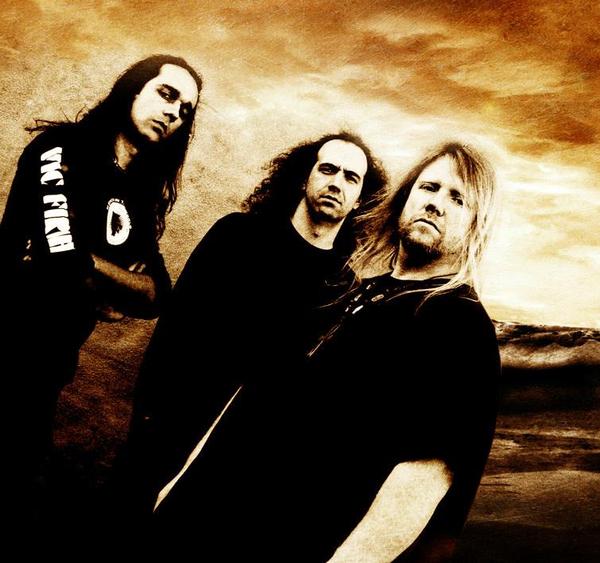
WTS: Having handled drumming duties on three albums so far with Nile, what is it about Nile, as a band, that keeps you going with them?

George: When I joined the band, the band was big enough, but not as big as we are today. To me, it was my favorite extreme metal band. So, to start with, I joined the band because it was my favorite band. That’s it. And why we keep going on? Because we fit together, we communicate very easily, we have fun, we are friends. You know, I think it’s the whole package, it’s what we do, we have the chemistry. I think that’s the most important thing. No matter how great a musician you are, if the chemistry is not there, it doesn’t really work and, thankfully, with Nile I found some good chemistry.

WTS: Is Nile recording any new material right now?

George: Right now, we are working on the new Nile album. We will probably get into the studio around November, December or January. That would be my fourth album with Nile.

WTS: From a drummer’s perspective, what is it that you think forms the primary component in Nile’s music? If someone was asked to drum for Nile, what attributes do you think he/she needs to have?

George: Nile is traditional death metal, so you gotta be able to play all these wonderful blasts. You gotta be able to play double bass drumming to a certain level, to a certain beats per minute. You gotta be able to play ‘cruiser’ extreme metal beats, you know. For example, no matter how fast are your beats, you gotta be able to keep it going, so you gotta have great stamina. There are so many fills, there are so many odd signature meters, you know. In ‘What Can Be Safely Written’, there’s a time signature that’s very weird, like a 30/16 on a breakdown and what I do is I follow the 30/16 and I break it down to groups of 3s. So, there are some rhythmic illusions going on in Nile’s music. So, in a few words, you gotta be able to play fast, you gotta have a good technique. Some drummers are faster, some are more creative, it depends. Nile has a little bit of everything. This why I really like the music.

WTS: Any plans for Nile to come to this part of the world?

George: We already tried three times to get to India and we failed three times. Right now, I’ve managed to come there myself. Everybody in the band is really happy atleast I made it. We actually agreed for a short tour very soon, that would be definitely within the next year – to come and do Singapore and all together, and maybe we will be able to come to India as well. Because, the last time we weren’t able to come to India was because the cost was too much for the band to fly to India – they were asking about $30000, you know. So, that’s too much money, but if we are touring in Singapore – very close to India – then it will cost us 1/3rd the amount to come to India and we can make it, and we will make it. We really want to get there. We have so many fans in India, we get so many mails. You know, this is something we talk about so many times. So, in a way, I’m happy it is happening, in a way atleast, with this drum clinic.

WTS: You started teaching drumming quite early – how has this worked in tandem with touring and gigging?

George: Well, I started teaching drums way before I joined the band. And then I joined Modern Music School and, now I’m drum instructor in Modern Music School in Athens – actually, worldwide, because our school is pretty big, we have like 70-something schools worldwide. So, sometimes we teach in different places. Last week I was in Germany teaching for the professional program of our school. It’s pretty tough with always touring and sometimes my students have to wait. But there is another way, they are lucky to have a touring drummer as a teacher instead of just having a teacher. Because, I tour different parts of the world and I can advise in different aspects and I think they like it even though it’s hard on everybody.
Interview with George Kollias

WTS: We see that you’re actively driving learning in metal drumming – what prompted you to make the instructional DVD Intense Metal Drumming?

George: The only reason I did was because of my love for music and for drummers. I wanted to share what I have and this is what I was doing online with my forum, this is what I was doing when I met fans – always talk drums, always share what I have. So, I wanted to be little more professional and little more serious, and release a DVD, which I did, and which, thankfully, went very well. And, right now, actually, I’m getting ready to shoot the new DVD to be out in January 2012.

WTS: Any other activities or ventures that your fans normally don’t know about?

George: These days I’m really busy. I did 4 albums for different bands. Actually, most of them were guest albums, like one song or three songs or whatever. I’ll be doing the new Cerebrum album – it’s a band from Greece, very technical metal. I’m working on the Nile songs and working on my solo project, which I think will be released early next year as well.

WTS: Give us some info about your solo project.

George: I got eight songs so far, everything is metal, black metal, it’s groovy in a way, it’s pretty fast as well. The music is almost ready. I’m working on the lyrics when I’ve the time. I don’t know when I’ll be able to record, but the sure thing is Eric Rutan from Hate Eternal wants to do the mix. So, Eric’s gonna be a big part of this CD. And, I’m gonna have many other guests – guitar players to play the solos. Everything is gonna be me, I’m gonna sing, I’m gonna play everything, I’m gonna write everything, except the guitar solo which I’m gonna leave to some guest guitarists.

WTS: Is this your first trip to India?

George: Yes.

WTS: Do you have any idea about the metal scene here in India?

George: I do have an idea because we have many fans there and I heard about a crazy crowd, the huge metal scene, and I’m very excited and I can’t wait to come there and play for you guys. I think it’s going to be a great clinic.
Interview with George Kollias

WTS: Give us a bit of info on the drum clinics you do. What can we expect in the drum clinic?

George: Well, I’m gonna be playing Nile songs for sure. It will be kinda like a show. I’ll present a few Nile songs, maybe a new song, let’s see. I’m gonna play some of my songs, maybe a few solos -depends on the time we have and the feedback we have from the crowd. And, of course, I’m gonna share some exercises and tips for the drummers. And, the main thing – and this is actually why we do the clinics – is for the drummers and fans to be able to communicate, come see and talk to you. In general, we’re gonna have a great great time.

WTS: What would be your advice to young budding drummers – the most important message you would like to give?

George: Get a teacher and get serious. That’s it. It is simple because most of the metal drummers are lazy, nobody is going for a teacher. I see with my students. When I was on my forum online everyone was like “Oh I wanna study with George, I wanna study with George.” And when I launch my online lessons I’ve only 20 people. So, yeah, I would like to see serious drummers. No matter where you are, there is always a great teacher. You gotta go there, you gotta pay him, of course. Because, you know, he will spend his time for you. If you wanna do it, do it the right way – find a teacher, open your mind to different styles of music, you know, be a drummer in general – not just blast beats, you know. That would be my message.

WTS: Anything else you would like to say?

George: Well, just looking forward to getting to India. I’m really excited. I’ve talked with many people, I get so many emails. So, I think it’s going to be a crazy day there. I’m really excited to see your beautiful country, and I’m really really looking forward to come there. I’ll be here this time for just one and a half days because there are many clinics before and after the one in India. I wish I had more days, but, unfortunately, I’ve to stay for one and a half days only. But, you know, it’s enough for me. I just wanna say to everyone, try and come for the clinics, meet me there, let’s have some fun, let’s talk all things drums. I’ll do my best to deliver one of the best shows you ever saw.

[facebookall_comments]

Thrash Revival: A God’s Lie by Devoid

Share

Is thrash metal dead? The genre that was most easily the ‘face’ of metal throughout the 80s and the 90s seemed like a lost art in the new century. With the most bankable names in thrash dishing out duds after duds, any metalhead worth his/her salt would say thrash is almost dead. A God’s Lie will change this perception.

The album marks the debut of six-year old Mumbai based thrash/ death metal outfit Devoid and talks about the violence of religion and the futility of it all. The album cover by Shakti Dash sums up the entire mood with illustrations that are startlingly smoky and blue with Goddess Kali in war mode. It’s dark, it’s heavy and it’s definitely not for the weak hearted.

A Silent Death’ makes for a brilliant opening for the album. The acoustic track sounds depressing, even suicidal and will leave you in a complete state of unpreparedness for the skull crushing riffs on the tracks that follow. ‘Battle Cry,’ right from its start of sirens wailing and gunshots to its riffs is reminiscent of the dying moments of Metallica’s ‘One.’

One of the most brilliant tracks on the album with its structuring is ‘New World Order.’ The track has parts of the goose bump inducing speech the character Howard Beale makes in the 1976 movie ‘Network’ about why people should get mad about everything wrong in the world. The title track, that comes in at the very end of the album stands out with its lyrics that slap you in your conformist faces. The other track that carves a niche for itself is ‘Black Fortress,’ a track that incidentally put Devoid into the spotlight in the Indian metal scene. ‘Possessed’ is a pure delight to hear for Shubham Kumar’s drumming. With lightning fast double bass beats, Shubham owns the track.

The bonus track, ‘Beer Song’ is an out-and-out old school thrash track that has ‘fun’ written all over it in capital letters. It’s the kind of track that would set the adrenaline pumping and lead to fractured limbs in moshpits at gigs.  Sanju Aguiar, who did a short stint as the lead guitarist for the band when their original man Keshav Kumar took a hiatus, returns to play on the bonus track, and boy is he fast!

Arun Iyer, with his raspy vocals, completely entices through the 38-odd-minute running duration of the album. Iyer’s crisp riffing provides Keshav ample opportunity to showcase why he is one of the best thrash metal lead guitarists in India. Frank Pawar, Devoid’s bassist, having played in several other bands is very seasoned to say the least, bringing his distinct touch to each track.

A God’s Lie isn’t about atheism; it’s about the flaw in religion that fails to save us from the monster that is politics. The idea is something that connects to Indians instantly and this works for Devoid. Both the band and the album are brutally honest and make no bones about it. The only issue with A God’s Lie is that the tracks lack this certain variation that would make them stand apart from each other.

A God’s Lie is that rare piece of a thrash debut whose copy you would want to preserve. Devoid is an extremely powerful band that shows promise like a pot of gold at the end of a rainbow. Thrashers around the world will agree that the album stands out not only because it’s from a Bollywood obsessed nation but because it’s genuinely world class. I’d rather listen to A God’s Lie than Slayer’s latest World Painted Blood, any day. Enough said!

[facebookall_comments]

The Mighty Riff at Alliance Francaise, Bangalore

Share


Recently, there’s been a lot of DIY-ism when it comes to metal gigs in Bangalore. The Mighty Riff was one such gig, organized by the musicians themselves, with a very spacious hall at the Alliance Francaise de Bangalore being used as the venue and an entry fee of just Rs 99. The bill consisted of CulminantBevar SeaInner Sanctum and Pillbox 666.

The venue seemed great. First impressions are often the last ones and we got a great impression of how loud and strong the sound could be, when Culminant started off. They started with one of their OC’s, covered Slayer’s ‘Raining Blood’ and followed it up with two more originals. The volume given to Bharad’s vocals seemed a bit low but the other instruments seemed perfect in the mix. Next up, they were covering Death’s ‘Misanthrope’ which was going perfectly until a technical glitch stopped them in between. Another attempt at the song, and the same result. They went on to perform another original and a third attempt at ‘Misanthrope’ resulted in the same glitch, which is where they decided to end their set. However, despite the technical issues they had made their mark and it was already a great start to the fest.

Bevar Sea, due to performing in a bigger venue, seemed less bassy this time and they were as good as they’ve always have been, if not better. Their set list consisted entirely of originals, which was great because they already have some very formidable compositions. Their set was lengthy, but had a flow of its own. They started with their often-used opener ‘The Smiler’ , followed by the Bangalore debut of their new song ‘Sleeping Pool’ , which managed to bring in loads of doom, especially in the last few minutes of the song. It was followed by the very catchy ‘Abhishtu’ , the upbeat ‘Universal Sleeper’ and the heavy set crawled to it’s finish with ‘Mono-gnome’ . Their sound always seems impeccable. Finding flaws in their set is like finding a needle in a haystack, and it was the same case in this gig as well. Another noticeable part was the crowd joining in on ‘Abhishtu’ something very rare in the Indian metal scene.

Inner Sanctum was the next much-awaited act, evident by the surge of crowd before their set, and the drop in numbers afterwards. Before the band got on stage, the artwork was on display, which was very impressive, to say the least. Shortly afterwards, the band took control of the scene, every song being as hard hitting as the previous one, with the sound seeming just right. Inner Sanctum has developed a dedicated following among the younger metalheads in namma Bengaluru, the mosh-happy kids expecting a mosh-worthy performance every time these guys play. This gig was no different, they delivered and how! The limited space in the hall was well exploited, with the crowd going berserk over their set list. The last track intensified their act with a Wall of Death which, though miniature, saw a good number of arms flinging around, kids thrown around. Now isn’t that just sweet? As it turned out, this was to be Rajeev the guitarist’s last gig, as frontman Gaurav Basu informed us that he’d be leaving the country for higher studies. This of course came with serious objections from the crowd, flipping the finger at the mention of ‘studies’. Rajeev was pulled off the stage for a crowd-surf by the fans (again a first, for any gig here!). A final group hug by all the members of the band and they were off! 

With covers of their “Gods” done “as they should be”, Bangalore’s new supergroup Pillbox 666 was the last band to take the stage. Their set list remained the same as their debut gig, but with an addition of Metallica’s ‘Whiplash’ Black Sabbath’s ‘War Pigs’ was also included, which had been skipped at their previous gig due to a broken guitar string. They started off with Black Sabbath’s ‘Black Sabbath’ followed by Slayer’s ‘Black Magic’, Black Sabbath’s ‘Electric Funeral’, Metallica’s ‘Whiplash’, Candlemass’ ‘Dark Reflections’, Autopsy’s ‘Ridden with Disease’, Black Sabbath’s ‘War Pigs’ and Motorhead’s ‘Overkill’, each cover ranging from great to magnificent. The guitar tone had that old-school raw edge and the bass was extremely prominent. The growling by Vikram Bhat provided chills, especially on songs like ‘Black Sabbath’, and ‘War Pigs’, and the drumming was absolutely perfect (Mr Raghu hasn’t disappointed us with any of his other projects, has he?). And it wasn’t just the tight covers. Pillbox 666 are an amazing live act, with Vikram Bhat clearly at the helm of affairs. Ganesh was on the vocals for ‘Whiplash’, (surprise!), the song itself a reminder of how Metallica was the band we all loved! Sigh. The TSF/UG crew (you know who you are!) deserve a special mention here, their controlled recklessness having fueled many a gig here in Bangalore before, and Pillbox 666′s set had them at full strength.

Apart from the live music, the fest did great with merchandise. All the four bands came out with t-shirts. At least four such poster designs could be seen for the fest, all of them with great artwork, two of which were put up for sale before the fest. CDs were also on sale at the merchandise stall and it’s always great to have something like that at a metal fest.

A great turnout despite the rains had proved that the metalheads inBangaloreare always up for a good gig, come rain, come shine. As we walked out of the venue with our necks aching and our ears still ringing from the onslaught, the only question on everyone’s mind was, “So, when’s the next one?”

[facebookall_comments]

Interview with Kryptos

Share

Kryptos is a melodic/thrash metal band from Bangalore. It was formed in 1998 by Nolan Lewis (vocals/guitars) and Ganesh Krishnamurthy (ex- vocalist/bassist). The band went on to release their debut album Spiral Ascent in 2004 and eventually went on to become one of India’s biggest Metal bands. In 2008,Kryptos released their second album The Ark of Gemini, under Old School Metal Records. Their music is an amalgamation of aggressive riffing, melodic lines and ambient drumming.

WTS: Tell us about how your band got started and took its first steps musically?

Nolan: The band started around ’98, it started with me and our ex-vocalist, his name is Ganesh. We were both classmates in Josephs Commerce College. He had another band, they used to play just covers and stuff, and they needed another guitarist so they asked me. But then that band broke up. Then we decided to do something on our own and we found this drummer from the north-east his name is Ching Len. We had put up an ad on one of our local music magazines and he answered that advertisement 8 months later! (laughs) Luckily by then we hadn’t found anyone so he joined us. It was just three of us in the beginning. We used to practice at the drummer’s place in Frazer town. It was a really tiny place, a small garage and we had terrible equipment, everything was terrible! (laughs) We were just doing it for fun that time. It was just like a hobby. There were quite a few metal bands back then like Millennium, Warden, Vulcan Haze, Crimson Storm, plus we had the other bands like Angeldust, Thermal and a Quarter etc. who used to play a lot.

Rohit: Around the same time that we started out, bands like Threinody and Myndsnare started. They started slightly before us, and we picked up after that.

WTS: How has the band evolved in terms of band members and how has that affected the music?

Nolan: Our drummer had to go back and take over family business, last we heard he’s into politics and stuff. (laughs) Ganesh lasted for quite a long time, he was with us for 8 years, but then had his own priorities and couldn’t dedicate enough time for the band so we just decided to part ways. Ryan joined in 2002-2003 and these guys joined in 2006.

Jayawant: November 2006!

Nolan: November 2006! (laughs) Yeah! Before that we had a guitarist called Akshay who was with us for 2 years or so and then he left. When Ryan joined we weren’t doing much, we were just playing competitions, playing covers and a few originals here and there. After he joined we started writing more stuff, it started becoming very stable, after we released our first album the other guys joined. Luckily it happened at a time when we could manage everything!

WTS: Was thrash metal a natural option for you to start off with?

Nolan: When we started off we didn’t know what we were playing actually. We had no idea what we should be playing. We used to just play covers, and the usual stuff – Iron Maiden, Judas Priest, Metallica. Nobody used to play originals then. Bands that played originals used to get booed. We had originals that we wrote which were pretty bad and whenever we used to play them at freedom jam and stuff people used to boo us, throw stuff at us, quite sad! (laughs) Back then we had very different preferences, I was more into thrash, Ganesh was more into blues, hard rock AC/DC stuff, our drummer was more into progressive music.

WTS: Were there other genres of metal that fascinated and interested you?

Nolan: Yeah, there was a point in time when Cradle of Filth and bands like that were really big in Bangalore for some reason. We also tried our hands at that, just to see how it goes. Back then we didn’t have a certain style, nothing. We even got a keyboardist for some time to see how it sounded. But then later on we figured out we’re no good at it! (laughs)

WTS: What bands could you consider as some of your influences or inspirations? Would you say that some of those influences are visible and can be tracked down in Kryptos?

Rohit: I hope that doesn’t happen! (laughs)

Nolan: Actually the good thing about our music is that our influences are all the old bands but we also put in some of the extreme types of music like doom, little bit of thrash, death metal here and there, so it’s like a mix. It sounds familiar but you can’t exactly pinpoint.

WTS: Are there any Melodic/Thrash Metal bands that have inspired you?

Nolan: Not really. The thrash bands weren’t that big of an influence. It was more like the 80s bands like Maiden, Priest. Maybe you could say Dark Tranquility was a big influence because they mixed death metal with the 80s metallic stuff. So, Dark Tranquility, In Flames and bands like that have definitely inspired us.

WTS: Could you tell us about your music making process?

Rohit: What we do is sit down and jam and whenever a song is good to our ears, we usually keep that. Let’s say Nolan has a riff, Ryan comes with a rhythm backing and if it sounds good to our ears then we build on it.

WTS: What are your rehearsals generally like? Do you guys have a set time during the week for that?

Ryan: We usually jam at 6:30 in the evening and it has worked out really well for all of us because even though these guys are working they put in a bit of effort and finish their work by 5:30-6:00. All of us make it for practice at 6:30. This happens every week, unless we have an interview or something! (laughs)

WTS: Tell us something about the releases you have had so far and what kind of plans you have for your future releases?

Jayawant: We got 2 albums down so far. First was in 2004, before Rohit and I joined the band; that was the old line up. With the new line up one of the first things we did was come up with new material. We recorded our second album in 2007 and finally launched that in 2008. We are currently working on our third album that we plan to record in February and hope to launch in March next year. We are experimenting a little with the lyrical content. As far the music goes, we’d like it to be more melodic, but we wouldn’t like to deviate from what we have already established as our genre.

WTS: How much has internet helped to get your band name around to people’s lips? What are some of the disadvantages of the internet in your opinion?

Nolan: It’s probably the most important factor in getting our stuff out. We actually had a tough time. The internet started becoming a useful tool only around 2005-2006. For the first seven years or so it was very tough. There weren’t any cellphones back then. At that time we didn’t know how to get in touch with people, nobody knew we existed. It was very difficult unless someone actually sees you. We only had landlines! If they had to call us we had to wait at home and wait till they call us. Of course, the main disadvantage is the downloading. Some bands don’t give their full album for download. They may give two or three songs. But now its picking up and people are buying a lot more CDs but college kids are the ones who usually download stuff. It’s alright to an extent because the music gets places, but it hurts the bands because they don’t make any money from whatever they invested in the first place.

WTS: What are the key elements of your sound?

Jayawant: A little bit of Lithium and Potassium…

Nolan: All the metals (laughs) Of course, the most important element is melody. Our songs have to have some melody, have some catchiness to it. There’s no point taking a bunch of riffs together, if it doesn’t make sense. We try and balance out the melodic stuff with the aggressive stuff, that’s exactly what our sound is actually. Back then most of the guys used to listen to old bands and stuff but now because of the new bands that are coming out, they are getting more brutal and aggressive and the audience is of course tuned into it. But today a lot of them are getting back into the old stuff. They get into that and start working their way backwards.

WTS: What is the most challenging and hardest thing for you in terms of song writing?

Ryan: Sometimes one of us has an idea, and we share it with the rest of the guys while jamming and then it is just inspiration and spontaneity. We just try different stuff out and we work it by ear. Sometimes a song works itself out. If you’re having a bad day you have to keep doing it over and over again, that is the tough part. When it’s a good day, we get it in just like one or two shots.

WTS: What are the main themes/topics in your songs? 

Nolan: We are not a death and destruction sort of a band. That’s too clichéd, that’s a stereotypical image that people have. For our first album Ganesh wrote all the lyrics and he had this very abstract way of writing lyrics. We tackled a lot of subjects like child abuse, sci-fi stuff and things to do with philosophy – he was totally into philosophy and stuff. For the second album, I started writing the lyrics. I’m very anti-religion, anti-politics, so those were some of the topics, mythology and a lot of environmental stuff too, there’s one song which deals with what the world will end up like if people continue to destroy the environment.

With the next album, the concept is a little weird, is sort of occult based and how it fits into the global scenario. Who is actually behind the scenes? Everyone thinks there’s good and evil. There’s God, the Devil, and the man stuck in the middle. But the next album is about how evil actually controls both sides. It’s like, God and man are puppets of the Devil. But he himself is the puppet of someone else who nobody knows. This kind of answers the question, why do so many bad things happen in the word and if God was actually there then why he doesn’t do anything about it? So he pretty much doesn’t exist. He is actually a creation of the Devil who himself is the creation of somebody else. (laughs)

WTS: Your last studio album ‘The Ark Of Gemini’ was released in 2008. When are you planning to record some new material?

Ryan: We are planning on recording the third album in Feb. I personally, want to get everything right this time. So I don’t mind taking the extra time and effort when it comes to practicing and of course, finding the right studio, getting the right sound, getting the right sound engineer and figuring out how much it all costs. I just don’t want to do the album and let it die down. Together all of us are planning things in such a way that we can do an album and start touring after that, and get shows so that everything works out in a sequence.

WTS: Tell us all about your tour across Europe. Was your music well received?

Jayawant: The tour… they were pleasantly surprised. What basically happened, was people expected something very Indian to be delivered as a part of our performance, but when they saw that it was genuine old school stuff, for a lot of the older guys it was a feeling of nostalgia which made them come right to the front and head bang, and for the younger crowd even though they were into different genres of metal they were still able to appreciate this as being something true and genuine. We got a fantastic response and got great feedback to the extent that they want us back again next year. Three different tour managers were interested in having us back there and play in a different set of clubs and festival venues. The response was really encouraging. It’s only the question of us saving up money so that we can go there and play again.

WTS: You’re the first Indian metal band to be signed by an International label. How did that happen?

Ryan: It happened because Nolan spent a lot of time on the internet!

Nolan: Actually back then we didn’t know much about labels. I had a fair idea about who would be interested,. Write up of our babnd and stuff. The name was Old School Metal Records and it was very obvious that that. This is how it used to be done, they were pretty impressed. They liked the music straight away. Next thing you know they’re sending us a contract.

WTS: Despite being the biggest Indian metal band and having an international label, why do you think it’s been generally hard for you to sell records overseas? Is it mainly the lack of touring?

Nolan: The main thing is the media exposure. You need a lot of marketing, promotion. The label that signed us is not that big a label. Their distribution reach is pretty limited. There’s a lot of work that can get people intersred, a lot of hype that goes into actually promoting a band out there. A lot of our CDs got sold over there, so it worked out quite decently.

WTS: How important is interaction among bands in India, do you think it’s necessary?

Ryan: It is necessary because when we started out all of us used to help each other, passing on a show to somebody else which you couldn’t do. Everybody used to do that. As far as I’m concerned I still do that. People have more attitude now, or…I don’t know! I’m pretty much in touch with everybody . Especially Rohit and Nolan… these guys make it a point to meet other bands and stuff like that.

WTS: What do you have to say about the current metal scene in India?

Nolan: They all split up. That’s a big problem actually. Bands get disheartened easily and there’s a lot of societal pressure. So bands crumble to that pressure.

Avatar photo

Priyanka Shetty

Priyanka Shetty is the founder of What's The Scene? Follow Priyanka on Twitter @priyanka_shetty

[facebookall_comments]